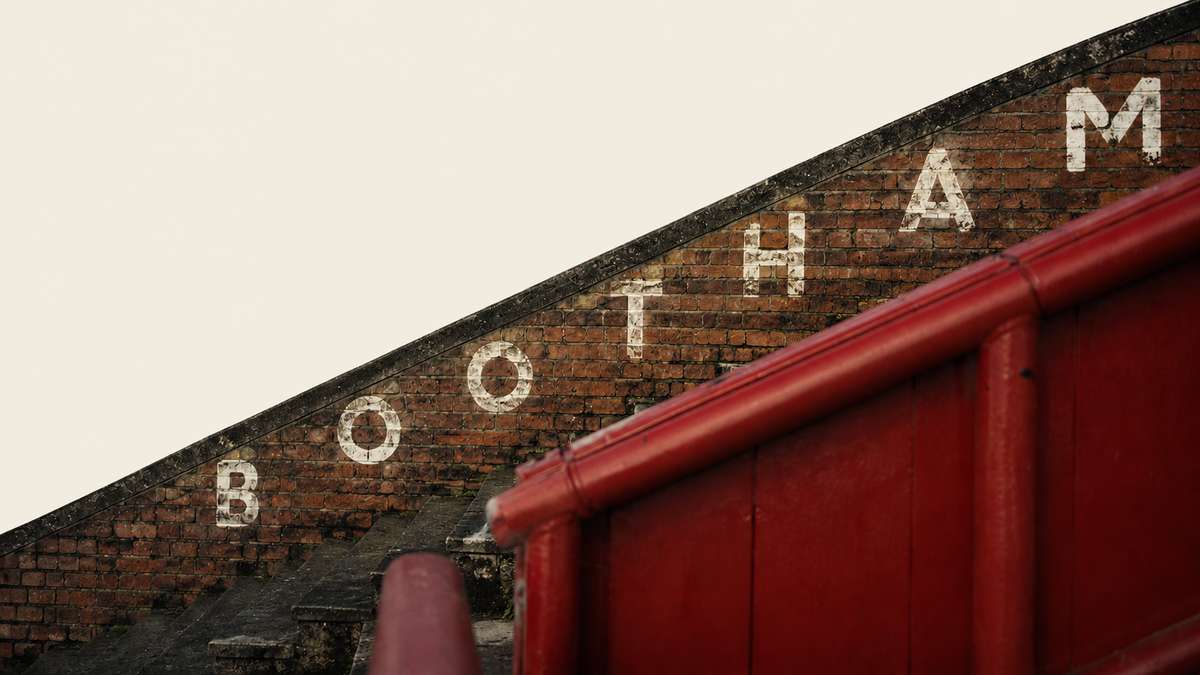
Bootham Crescent: The Lost Ground York Left Behind
York City return to the Football League this summer, just as a memorial garden opens where Bootham Crescent stood for 88 years, with a preserved terrace, a wartime tunnel and an original turnstile. The story of a lost ground, and what remains.
York City Back in the Football League, with the old ground gone
York City begin the 2026/27 season in EFL League Two, back in the Football League for the first time in ten years. The title was won in the maddest way imaginable, a 103rd minute equaliser at Rochdale on the final day of the season, two pitch invasions, and a championship decided by a single kick.
But this piece is not about the season ahead. It is about the ground that will not see it.
Because this summer, as York prepare for league football again, a memorial garden opens a mile from the city centre, on a housing estate where Bootham Crescent stood for almost ninety years. There is a turnstile in it.
A ground built in four months
York City spent their first decade at Fulfordgate, out on the southern edge of the city, a long trudge from the railway station at the end of a single track tram line. Attendances fell, the directors blamed the location, and when York Cricket Club vacated Bootham Crescent in January 1932, the football club saw its chance.
The shareholders voted 115 to 37 to move. The new site was an awkward wedge of land hemmed in by a barracks, a school, almshouses and terraced streets, but it sat near the heart of the city, with ten times the population of Fulfordgate living within a mile. Local architects Ward & Leckenby drew up the plans, sections of the old terrace cover were carted across the city and rebuilt as the Popular Stand, and the whole ground went up in four months. It opened on 31 August 1932.
The club bought it outright in 1948 for £4,075. It would be home until 2021.
The tunnel that sheltered a school
Bootham Crescent carried the Second World War in its bones. A tunnel ran beneath the Popular Stand, built so home and away supporters could swap ends at half time. When the war came, it became an air raid shelter for 432 pupils and staff of the school next door on Shipton Street. The ground itself took slight damage when a bomb fell on the houses along the Shipton Street End.
Five plaques commemorating York players who died in the Second World War hung at the ground for decades. When the club finally left, the plaques went with them to the new stadium. The tunnel stayed.
Floodlights, upsets and 28,123 souls
The ground's record crowd came early: 28,123 for an FA Cup tie against Huddersfield Town in March 1938, a scarcely believable number for a ground that held 8,256 by the end. Floodlights arrived in 1959 and were replaced in 1995 by a set twice as powerful, the pylons visible across the rooftops of Clifton.
The FA Cup kept coming back. In 1985, York beat an Arsenal side containing eight internationals, Keith Houchen scoring the only goal in one of the great upsets in the competition's history. And in a stranger footnote, the ground spent the late 2000s renamed KitKat Crescent under a sponsorship deal with Nestlé, the city's chocolate maker. Supporters mostly refused to say it out loud.
The stand named for David Longhurst
On 8 September 1990, York striker David Longhurst collapsed on the pitch during a match against Lincoln City and died. He was 25. The following year the club roofed the Shipton Street End and named it the David Longhurst Stand, and the name held for the remaining three decades of the ground's life.
When the streets of the new housing estate were named, the club asked that they honour York City players no longer living. David Longhurst Way is among them. His name outlasted the stand.
The last goal nobody saw
The final competitive match at Bootham Crescent was played on 28 December 2020, behind closed doors in the depths of the pandemic. York beat Guiseley 1-0, a goal from centre back Josh King. Nobody in the ground knew it was the last one. With fixtures postponed and the move to the new stadium repeatedly delayed, it was only confirmed afterwards that the goal, the game and the ground were finished.
Eighty eight years of football, and the last goal was scored in silence.
What the bulldozers left standing
The site was handed to Persimmon Homes in April 2022 in a deal worth £7 million, and by early 2023 the ground was gone, cleared for 93 new homes. But Bootham Crescent became something rare among lost grounds: a demolition treated as heritage.
Historic England worked with the club and the York City Supporters Trust on what should survive. A section of the Popular Stand terrace was kept, along with its wartime tunnel. The original turnstiles were saved to stand inside it. Half of the old centre circle is engraved in stone paving. A flagpole rises at the entrance, recalling the five minute flag that was lowered from the corner of the ground to tell the crowd how long remained.
Archaeologists even excavated the pitch itself, recovering the ashes of supporters who had been laid to rest in the turf over the decades, so they could be moved with care to the memorial garden. One woman helped dig for her sister, whose ashes lay in the home goalmouth.
Back in the Football League, with the old ground gone
The memorial garden opens in the summer of 2026. The timing is almost too neat. In the same weeks that supporters walk through a preserved turnstile into a garden built on their old terrace, York City will kick off in League Two, back among the 92 for the first time since 2016.
The Supporters Trust will run the garden, and they talk about it becoming a pilgrimage site for football people, with walks planned from Bootham Crescent to the new stadium at Monks Cross. That feels right. Every supporter of a certain age has a Bootham Crescent of their own, a ground that lives now only in street names and the memory of a floodlit sky.
York go up. The ground stays down. Both things are true at once, and that is football nostalgia in its purest form: the future arriving, and the past holding its ground.
This post was brought to you by The CobbleRose Shop