
Football on the Somme: The Game That Refused to Die
On the opening day of the Battle of the Somme, thousands of soldiers went over the top into history's bloodiest battle. Yet behind the trenches, football endured. This is the remarkable story of how the game survived the First World War and helped soldiers cling to their humanity.
The footballer's Victoria Cross
On 1 July 1916, while whistles shrieked across northern France and thousands of British soldiers climbed from their trenches into machine gun fire, football did not stop. It simply changed its ground.
The opening day of the Battle of the Somme became the bloodiest day in the history of the British Army. Of the 120,000 men who left their trenches that morning, 57,470 became casualties. More than 19,000 were killed. Entire streets, villages, factories and football clubs would never look the same again. The Somme is remembered through military maps, trench systems and endless rows of white headstones. Yet woven quietly through that story is another one. The story of football.
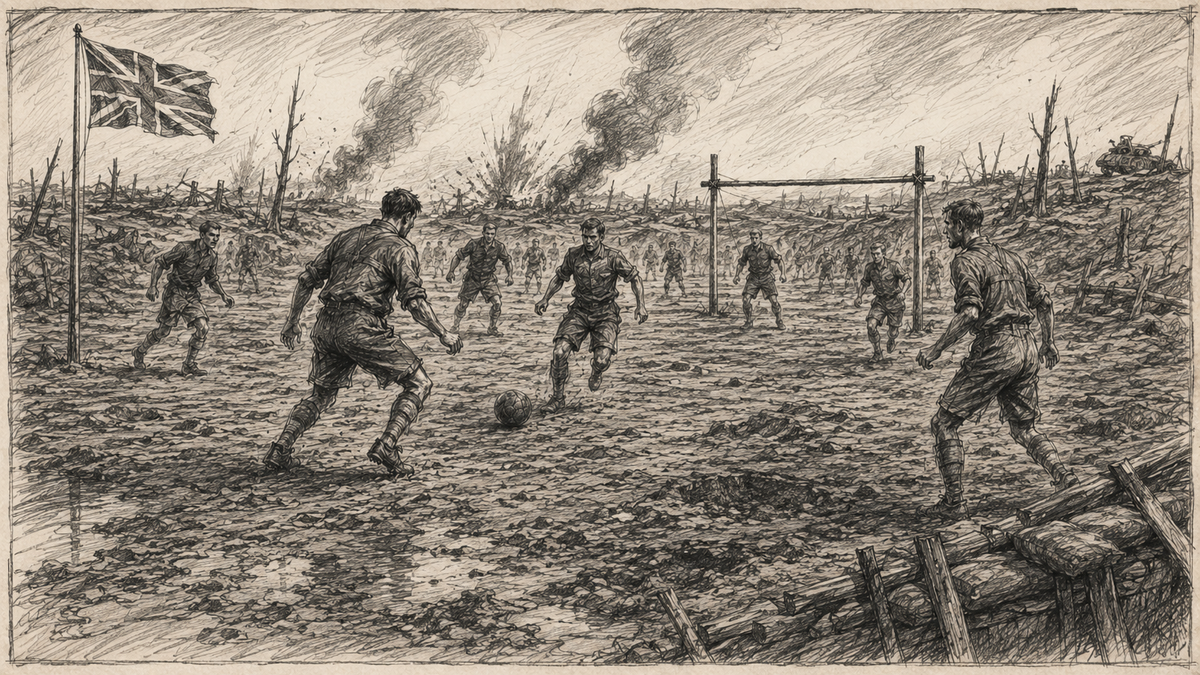
Not the game played before packed terraces at Goodison Park or Hillsborough, but the game played behind the lines, between shell holes, on strips of frozen mud where the goalposts were greatcoats and the ball competed with the distant rumble of the guns. And, on one extraordinary morning, the game played in No Man's Land itself, kicked towards the German wire by men who knew exactly what was waiting for them.
The game Britain argued over
By the summer of 1914, football had never been more popular in Britain. The Football League was thriving, attendances regularly passed 30,000, and Saturday afternoons had become almost sacred across industrial Britain. Then came the assassination at Sarajevo, the ultimatums, mobilisation and war.
Unlike France and Germany, Britain initially chose to continue professional football after August 1914, and it proved enormously controversial. Newspapers asked why healthy young men were chasing a ball while soldiers were dying in Belgium. Recruiting posters appeared outside grounds. Thousands of professionals volunteered immediately. Thousands more did not, often because families depended on their wages, or because clubs argued the game gave civilians something to hold on to. Public opinion settled the argument. By the end of the 1914 to 1915 season, competitive league football was suspended indefinitely.
The terraces emptied. The trenches filled. Football packed its boots.
The footballers' battalions
The first move came not in London but in Edinburgh. In November 1914, Sir George McCrae raised the 16th Royal Scots, the original footballers' battalion. Sixteen players from Heart of Midlothian enlisted, the first British club side to sign up together, and at least five hundred of their supporters followed them into the ranks. Hearts were top of the Scottish league at the time, unbeaten and playing the best football in Britain. Exhausted by military training, with players missing week after week, they were overhauled by Celtic in the spring and never got that title back.
A month later, London answered. The 17th (Service) Battalion, Middlesex Regiment, the Footballers' Battalion, was raised in December 1914 and drew professionals, amateurs, referees, club officials and supporters from across the country. The roll call reads like a lost edition of the Football League handbook.
Walter Tull, one of England's first Black professional footballers, enlisted three days before Christmas 1914 after playing for Tottenham Hotspur and Northampton Town. He fought through the Somme at Delville Wood and Guillemont, was commissioned as an officer despite military law that expressly barred it, and became one of the first Black officers to lead white troops in the British Army. He was killed near Bapaume during the German Spring Offensive of March 1918, hit by machine gun fire as he tried to rally his men. His body was never recovered.
Frank Buckley survived the Somme after shell shock and gas, and went on to manage Wolverhampton Wanderers. Vivian Woodward, England captain and perhaps the finest amateur footballer of his generation, was seriously wounded. Many never came home at all.
Two footballs at zero hour
The most famous kick of the entire war belonged to a man who was not a footballer at all. Captain Wilfred Nevill of the 8th East Surreys, known to everyone as Billie, was a cricketer and hockey player, a company commander not yet twenty two. On leave in May 1916, he bought two footballs and carried them back to France. On one he wrote: The Great European Cup Tie Final. East Surreys v Bavarians. Kick off at zero. On the other, in large letters: No Referee.
His idea was simple. When the whistle blew, his men would cross No Man's Land towards Montauban behind something reassuringly familiar. At 7.27 on the morning of 1 July 1916, as the barrage lifted, Nevill and a fellow officer punted the balls out of the trench, and the East Surreys followed them over the top, dribbling and booting them forward under staggering fire. The advance stalled at the German wire. Nevill dashed to the front to move it on and was killed instantly, two weeks short of his birthday. The officer who had kicked off the second ball died alongside him.
The East Surreys took their objective. Both footballs were recovered from the battlefield the following day. One survives at Dover Castle. The other was lost in the Clandon Park fire of 2015, having outlived every man who kicked it by nearly a century.
Donald Bell The footballer's Victoria Cross
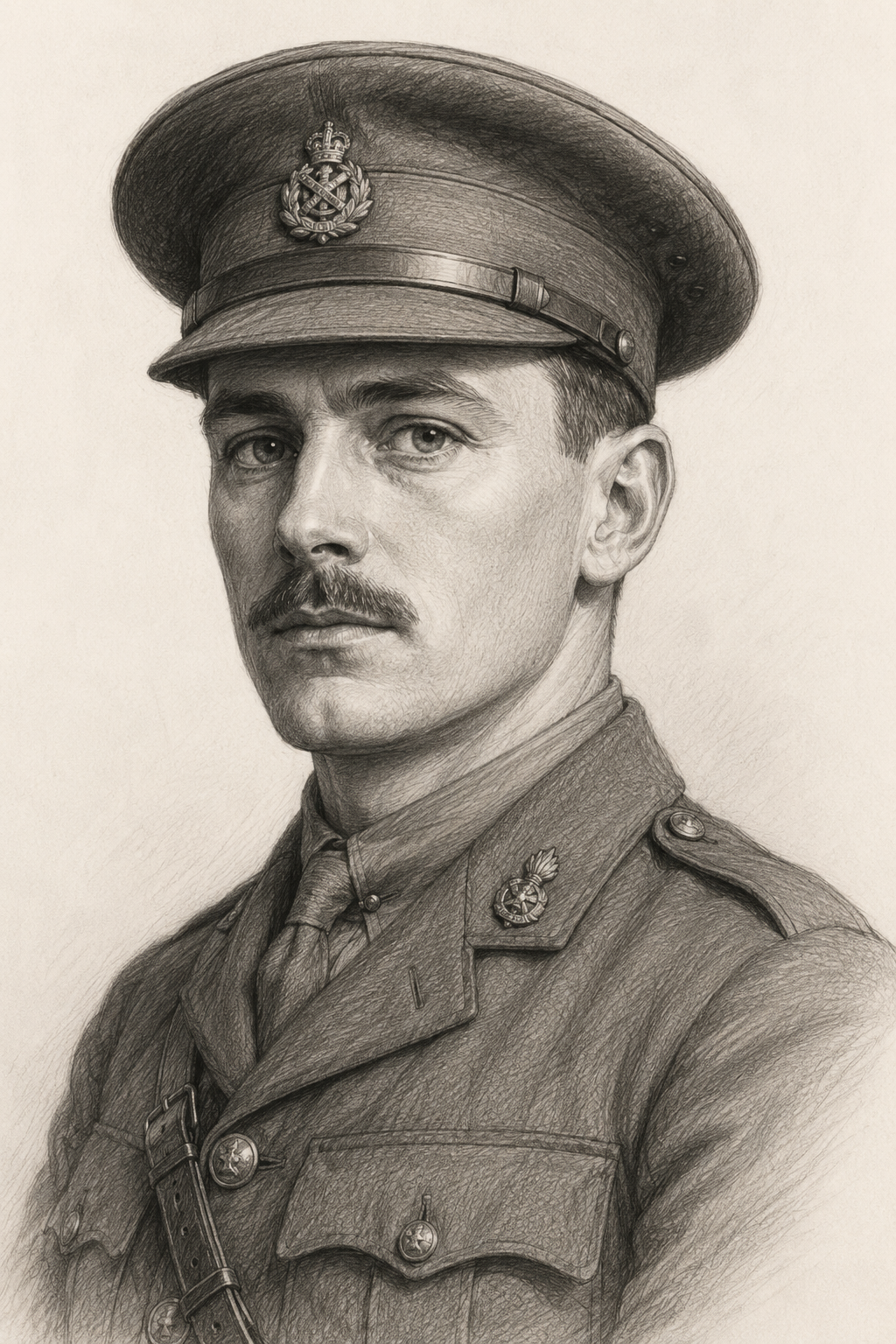
Nine days into the battle, the game lost the first professional it had sent to war. Donald Bell, a schoolteacher from Harrogate who signed for Bradford Park Avenue in 1912, was the first professional footballer in Britain to enlist, writing to his club that he was duty bound to join the ranks. On 5 July 1916, at Horseshoe Trench, Second Lieutenant Bell ran across open ground under heavy fire and silenced a German machine gun with his revolver and a handful of bombs. In a letter home he called it the biggest fluke alive. It earned him the Victoria Cross, the only one ever awarded to an English professional footballer. Five days later, attempting an almost identical act of bravery near Contalmaison, he was killed. His medal sits today in the National Football Museum, bought at auction by the players' union.
Contalmaison. The same village McCrae's men had bled for on the first morning, when the 16th Royal Scots lost nearly three quarters of their attacking strength and still reached their objective. Among the dead were three Hearts first team players: Duncan Currie, Ernest Ellis and Harry Wattie. A cairn of Scottish sandstone stands in the village now, and every year on the first of July, people gather beside it.
The game behind the lines
Away from the set piece tragedies, football simply carried on wherever the war allowed it. The sport arrived in France almost as quickly as the soldiers themselves. Every battalion seemed determined to organise matches, and commanding officers encouraged them, because medical officers had noticed something. Men who played football laughed more, argued less and came out of the line mentally stronger. Long before anyone understood post traumatic stress, the Army recognised that organised sport provided something medicine could not.
Footballs became a fixture of the supply depots. Brigade championships were fiercely contested behind the Western Front. Engineers played artillerymen, infantry challenged medical corps, Scottish battalions faced Yorkshire regiments, and crowds of several thousand soldiers gathered to watch. With so many professionals in uniform, the standard was astonishingly high.
Whenever battalions rotated out of the front line, the matches reappeared almost immediately. Goalposts were improvised from rifles or signal flags. White tape marked the touchlines. Spectators sat on ammunition boxes and the remains of trench parapets. Sometimes the pitch was interrupted by shellfire, and the match simply paused until the barrage moved elsewhere. The game adapted because the players needed it to.
The truce that grew in the telling
One story deserves honesty. There is no reliable evidence that the Christmas Truce of 1914 produced an organised match in No Man's Land with proper teams and rules. Contemporary accounts describe kickabouts and balls exchanged between British and German soldiers at several points along the line, but the romantic image of an eleven against eleven international was built up over decades. The truth is less cinematic and perhaps more powerful. Even in the middle of the most industrialised slaughter in history, men instinctively reached for a football. That instinct never left them.
What football carried home
The war reshaped British football long after the Armistice. Hundreds of professionals never returned. Many who did came home carrying wounds both visible and invisible. Attendances surged once peace came, because football offered communities exactly what they needed: normality, shared experience, escape.
Memorials appeared inside grounds. Roll of Honour boards listed players, officials and supporters who never came home. Cup finals observed silence before silence became common anywhere else. Today, when supporters lay wreaths beneath stadium memorials each November, they are acknowledging a bond between football and military service that stretches back more than a century. Every professional club in Britain carries names in its history books that end abruptly between 1914 and 1918.
The Battle of the Somme was never about football. It was about unimaginable human cost. Yet football became one of the threads that helped thousands of men hold on to their humanity amid that cost. A ninety minute reminder that they were still fathers, brothers, sons, miners, factory workers and centre forwards, rather than soldiers known by service numbers.
The final whistle blew on the Great War in November 1918. For many, it came far too late. But on fields across France, often within earshot of the guns, and once, unforgettably, in No Man's Land itself, football had quietly done something extraordinary.
It refused to surrender.
Read Tom Finney and football with the 8th Army.