
The Desert XI: Tom Finney's War in the Sand
Three days after a wartime final at Wembley, Tom Finney was on a troopship to the Egyptian desert. He gave his prime to the Eighth Army, played football on the sand, and came home one of England's greatest. The first name on the Desert XI team sheet.
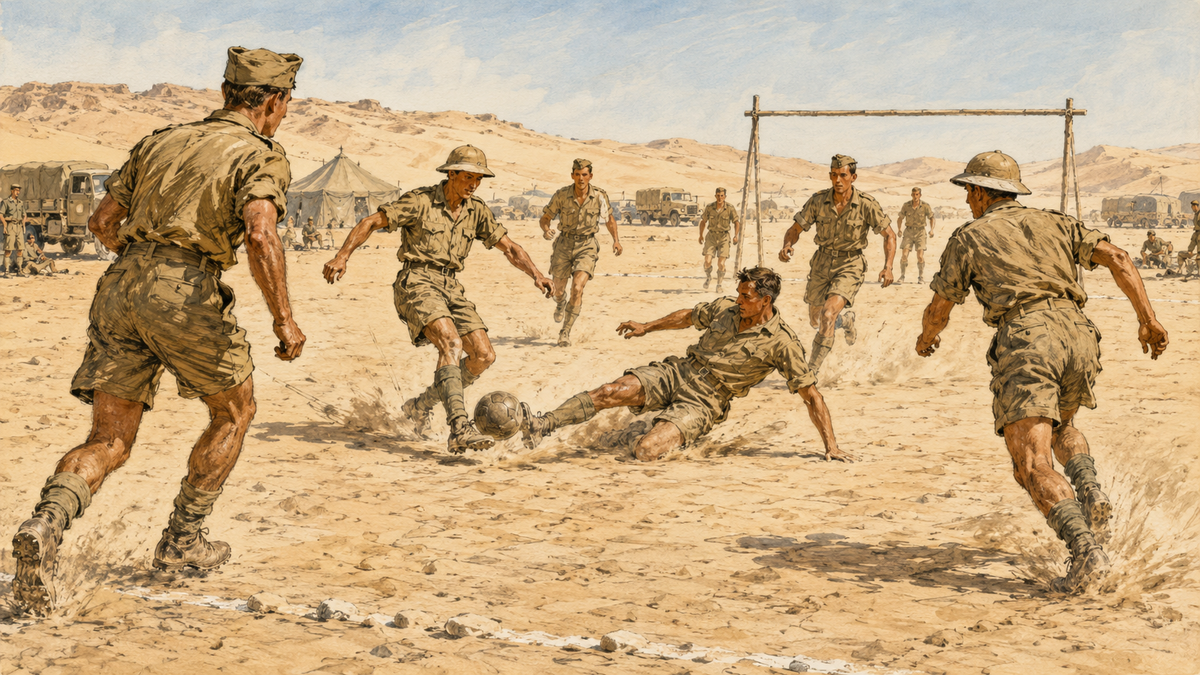
Three days. That is all that stood between Wembley and the war
In May 1941, a young Tom Finney played in a Wartime Cup final for Preston North End, setting up a goal against Arsenal in front of a Wembley crowd. Within days the football stopped. By April 1942 he had been called up, and that December he was on a troopship bound for Egypt, posted to the Royal Armoured Corps and the Eighth Army. He would not play a single official league match for Preston until 1946. The desert took the best four years a footballer has, the years from twenty to twenty four, and it never gave them back.
This is where the Desert XI begins. Finney is the first name on the team sheet, out on the right, because his story holds the whole idea in one man: the boy from the terraced streets who became a soldier in the sand, then came home and became one of the greatest players England has ever produced.
From Deepdale to the desert
Finney grew up a few hundred yards from Deepdale, close enough to hear the crowd. As a boy he worshipped the Preston inside forward Alex James, copying his swerve in the street with a tin can for a ball. He signed for Preston as a teenager and learned his trade under a young wing half named Bill Shankly, the man he later called his football mentor. The talent was obvious early. At nineteen he was good enough for a Wembley final.
Then the letter came. Aged twenty, Finney joined the Royal Armoured Corps and trained to drive and maintain tanks. In December 1942 he was shipped to Egypt to join Montgomery's Eighth Army for the closing stages of the desert campaign, the long pursuit of Rommel west across Libya. The Preston winger was now a trooper in the sand, a long way from the green of Deepdale.
Football on the sand
The game never quite let go of him. When leave allowed, Finney turned out for army sides against local opposition in North Africa. One of those local teams fielded a teenage substitute who, years later, introduced himself to Finney as the actor Omar Sharif. He had been on the bench the day the Preston winger came to play. It is the kind of detail that tells you how strange and small the world became out there, footballers and future film stars passing a ball across the same desert.
When the campaign in Africa was won, Finney went on to Italy. He served in the reconnaissance troop of the 9th Queen's Royal Lancers as a Stuart tank driver, and in April 1945 took part in the final offensive at the Battle of the Argenta Gap. He had gone to war a promising winger and come through it a soldier, having crossed the same ground, the same heat and the same pinkish desert light that gives this brand its name.
The years the war kept
Finney was demobbed in early 1946. League football resumed that August, and he made his Preston debut against Leeds in a side that included Shankly, winning 3 to 2 on what he called a carnival sort of afternoon. Twenty eight days later he played for England, scored in a 7 to 2 win in Belfast, and called it his proudest day in football.
What followed puts the loss into sharp relief. He won 76 caps and scored 30 goals for England. He could play anywhere across the front line, on either wing or through the middle, and was never once booked or sent off in a career that ran all the way to 1960. He stayed at Preston for the whole of it. In 1952 the Italian club Palermo offered him a fortune to move, a signing fee many times his Preston wage, a villa, a sports car, but the club refused to sell and Finney stayed loyal, running his plumbing business on the side and earning the nickname the Preston Plumber.
And still you wonder. If the desert had not taken the years from twenty to twenty four, what would the full record have been. That is the quiet tragedy stitched through every man in this series. They gave their best years to a war, played their football on sand and snow and frozen Italian hillsides, and asked for nothing back.
The first name on the team sheet
That is why Finney wears the number seven in the Desert XI. Not only because he was a winger of rare grace, but because he carried the whole story in his boots: Wembley to the Western Desert and home again, the terraces and the sand, the green pitch and the pink horizon. Next in the side comes a captain, a man who led his entire team to the recruiting hall together and did not come home.