
Floodlight Pylons: The Lost Landmarks of the English Away Day
You always saw them before you saw the ground. The floodlight pylon was the most honest landmark in English football, and then, quietly, it vanished. A story of steel, light and the away day skyline we lost.
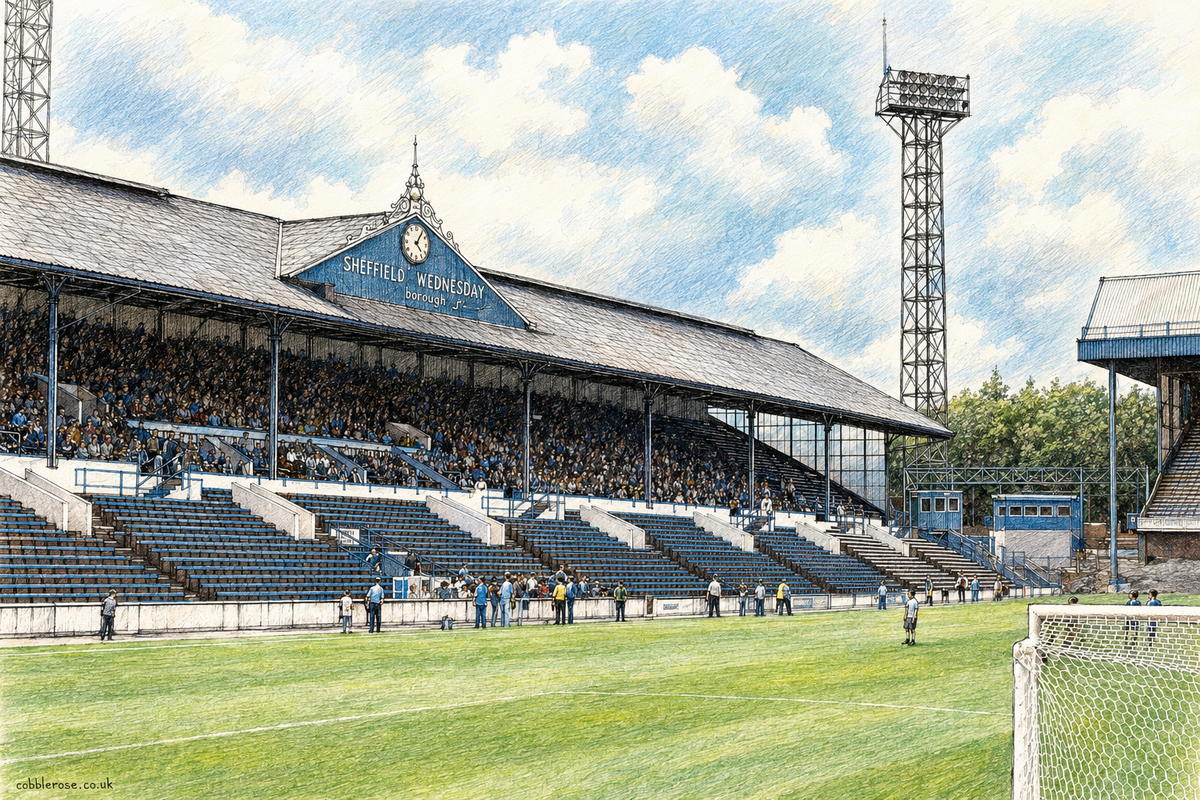
You always saw the floodlights before you saw the ground
Long before the satnav, before the printed route folded into the glovebox, the floodlight pylons did the navigating for you. You'd come off the ring road into a town you half-knew, lose yourself in a tangle of terraced streets, and then there, above the chimney pots stood four tall towers of latticed steel, lamps blazing against a grey northern sky. Sometimes it was six towers, or five in the case of Sheffield Wednesday and Sheffield United, respectively. That was the signal. The away day had begun. The ground was close. You followed the lights the way earlier travellers followed church spires, because that, more or less, is what they were: the cathedrals of a working-class Saturday.
For forty years or more, the football floodlight pylon was the most honest landmark in England. It didn't pretend to be beautiful. It was scaffolding with a job to do, bolted together in the same yards that turned out pit headgear and gasometers and railway bridges. And yet, lit up on a midweek night, it was the most romantic thing in the league.
The cathedrals of light - Elland Road, Hillsborough and Bramall Lane
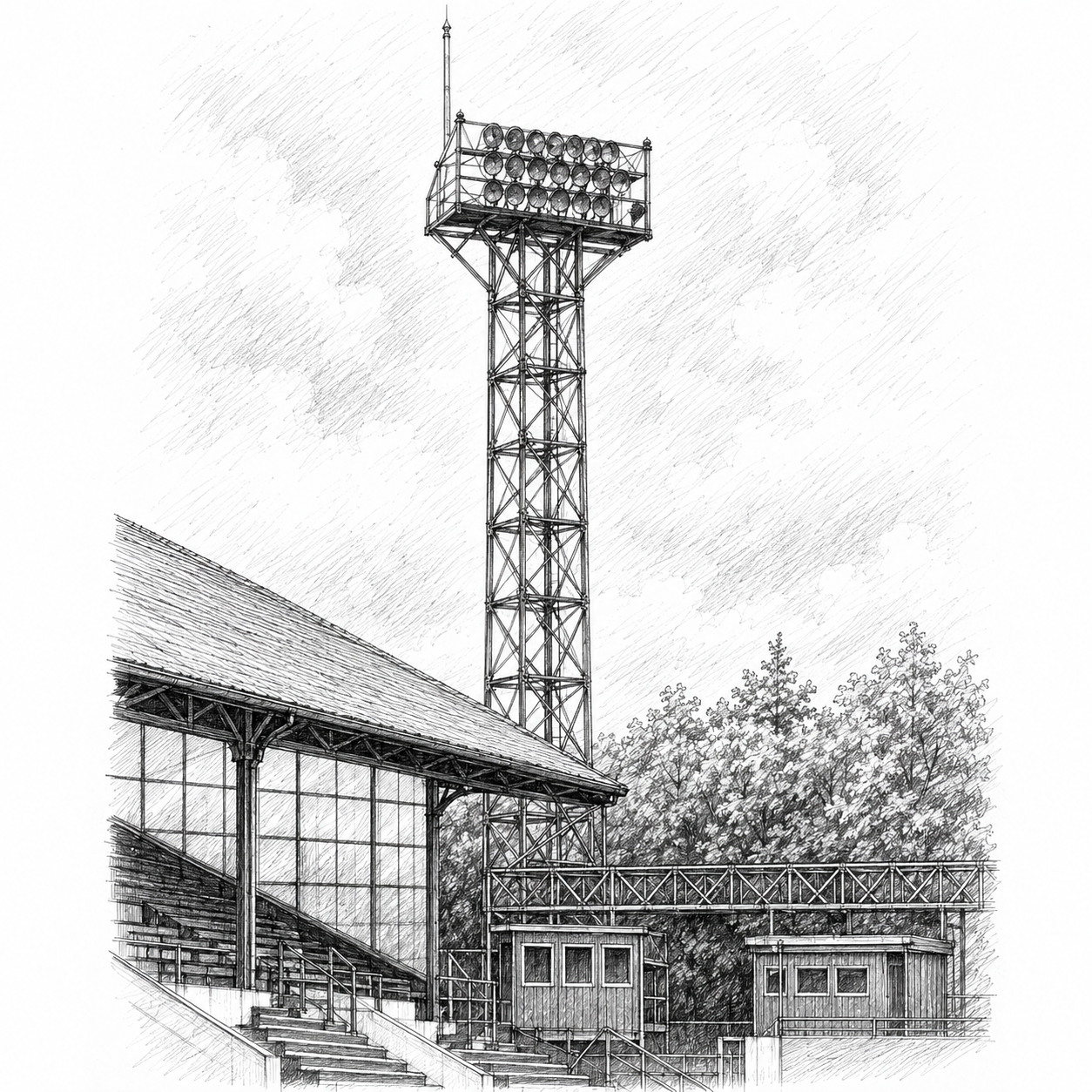
Some grounds did it better than others.
Nowhere did it better than Elland Road. When Leeds United raised their floodlights, they didn't settle for the usual four-square towers they built diamonds. Four great latticed columns, each crowned with a blazing diamond of lamps, went up between 1973 and 1978. At just under eighty metres they were, for a time, the tallest floodlights in Europe: visible for miles across the rooftops of Beeston, a beacon drawing supporters in from across the city. They cost fifty thousand pounds, weighed twenty tonnes apiece, and threw out enough heat from a single bulb to match a two-bar electric fire. They lasted barely twenty years. When the new East Stand rose in 1993, the diamonds came down, first on the east side, then the last pair to the west, and the South Leeds skyline lost its crown.
Cross into Sheffield and the city gave you two very different silhouettes. Hillsborough, home of Sheffield Wednesday, broke the rules entirely: where almost every other ground in the country made do with four pylons, the Owls stood beneath six. Six towers ringing the pitch, a forest of light unlike anywhere else — the kind of detail a young fan never forgot, and that old ones still argue about in the pub.
And then there's Bramall Lane, where the whole story starts. Long before any of those towers were dreamt of, Sheffield United's ground hosted the first floodlit football match in history, back in October 1878, lamps powered by rattling dynamos, an experiment in seeing the game after dark that the rest of the world spent the next seventy years catching up with. Every pylon that ever rose over an English ground traces its line back to that night on the Lane.
Why English football tore down its floodlight pylons
So where did they go?
The short answer is that the pylons didn't fail. The grounds outgrew them.
The turning point was the Taylor Report. In the wake of the 1989 Hillsborough disaster, its recommendations forced the top two divisions toward all-seater stadiums, and through the early 1990s English football tore itself down and rebuilt. New stands rose where open terraces had stood, taller, fully roofed, cantilevered out over the pitch.
And that, quietly, is what killed the pylon. Once a ground had high, continuous roofs running the length of each side, you could bolt the lights straight onto the roofline, something that had never been possible when stands were low and terraces lay open to the sky. Elland Road, Old Trafford and Anfield were among the first big grounds to make the switch, in the early nineties. Roof-mounted lighting was cheaper to run, far easier to service, no lowering rigs, no cherry-pickers swaying eighty metres up, and it kept the broadcasters happy as television's demand for even, glare-free light grew season on season. Later, energy-efficient LED arrays finished what the rebuild had started.
One by one, the towers came down. Some were felled in an afternoon. Others simply vanished between seasons, so that you'd return to a familiar ground in August and find the horizon subtly wrong, the skyline lowered, the old marker gone.
What we kept
What disappeared wasn't just a way of lighting a pitch. It was a way of finding your way home.
The modern stadium is a better building, warmer, safer, brighter, sharper on the television. But it doesn't announce itself from three streets away. It doesn't rise over the rooftops to tell a coachload of away fans that they've nearly made it. That job belonged to the pylons, and when they went, something in the texture of the away day went with them.
That's why the silhouette still pulls at us. Stripped of crest and colour, a floodlight pylon belongs to no single club and to all of them at once — pure shape, pure memory, the steel skeleton of a thousand Saturday nights. It stands alongside the turnstile, the corrugated stand and the worn terrace step in the visual language of a game that has changed almost beyond recognition, and yet still feels, to anyone who stood beneath those lights, like home.
The grounds moved on. The lights stayed with us.
Thank you for visiting CobbleRose
This post was brought to you by The CobbleRose Shop